
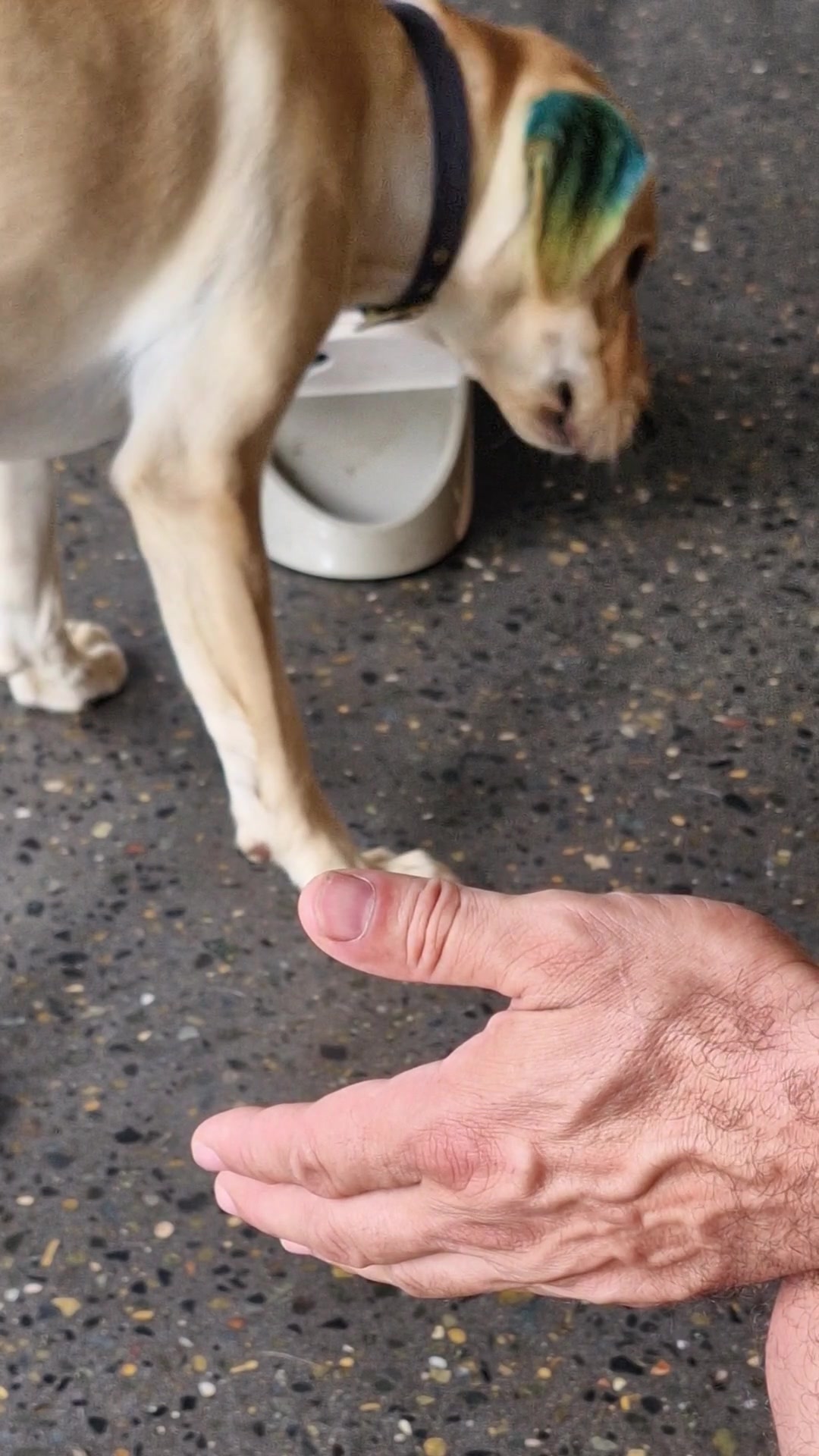
There’s something absolutely brilliant about watching a dog work something out for itself.
A little investigation. A nose touches a hand. CLICK! A food reward follows.
And then the dog comes back to try again.
That’s what I love about clicker training. We’re not just teaching a behaviour. We’re creating an opportunity for the dog to discover what works, become more engaged and actively participate in learning. And I want to show you exactly how that happens in a real training session.
Watch this Labrador discover the hand touch
Watch the sequence: voluntary nose touch → click at the instant of contact → reward at the Treat Train → return for another opportunity.
In this video, I present my hand and allow the Labrador to investigate. I’m not putting food in my hand to lure the dog into touching it, and I’m not physically placing the dog’s nose against my palm.
The dog offers the nose touch voluntarily.
CLICK! That’s the exact instant I mark.
The dog then heads over to the Treat Train food dispenser, collects its reward and comes back. I present my hand again; the dog touches it again. CLICK! Another reward follows.
That’s the part I want you to notice: the dog is learning that its own actions can produce an outcome. It’s starting to understand the game!
What is clicker training?
Clicker training is a form of positive reinforcement dog training that uses a distinct sound to identify the precise moment a dog does something we want to reinforce.
Imagine taking a photograph of that instant. The click tells the dog, "YES! That behaviour right there earned the reward!"
The click is called a marker. At first, it’s just a sound. When we consistently pair it with something the dog enjoys, such as a small food treat, the sound becomes meaningful. It predicts that a reward is coming and helps the dog identify which action earned it.
The distinction matters: the click marks the behaviour; the reward that follows reinforces it. The click is not a substitute for paying the dog.
A handheld clicker is convenient, but it’s not magic. A consistently used verbal marker like "Yes!" can serve a similar purpose. The real skill is your timing, your reward delivery and your understanding of what motivates the individual dog.
Why is this hand-touch exercise so exciting?
Because the dog is taking part in the discovery.
In the demonstration, I’m reinforcing a voluntary hand touch. In training terms, this is capturing an offered behaviour. It also shows the same principle we use in shaping: rewarding achievable steps towards a goal, rather than insisting on the finished behaviour immediately.
If a beginner dog doesn’t offer a nose touch yet, we can shape it in little stages: looking towards the hand, moving closer, bringing the nose near it and eventually making contact. Mark and reward each small success before asking for a little more.
But when a dog offers the complete touch, as this Labrador does in the video, there’s no need to complicate it. Catch that moment, mark it clearly and reward it.
Then watch what happens when the dog is given another opportunity.
It’s not about forcing a response. It’s about making success understandable and worth repeating.
Why use a Treat Train reward machine?
There’s an interesting detail in this video: the food isn’t coming from the hand the dog is touching.
The hand is the target. The Treat Train dispenser is where the dog collects the reward.
That makes the sequence easy to see:
Touch the hand → hear the click → collect food → come back → offer the touch again.
Separating the target from the reward location can help reduce dependence on seeing food in your hand. It also makes for a fantastic demonstration of the dog choosing to return and repeat the exercise.
You don’t need a machine to try this at home. A handheld clicker, a treat pouch and good timing are enough. Whatever you use, deliver the promised reward after the marker.
Why does positive reinforcement work?
In learning theory, positive reinforcement means adding something the dog values after a behaviour, making that behaviour more likely to happen again.
It isn’t just about handing out treats. It’s about finding out what the dog enjoys, setting up an achievable learning opportunity, marking the successful choice and rewarding it well.
When the dog understands that connection, we can build enthusiasm, confidence and a willingness to try. We can reinforce an offered behaviour instead of constantly prompting or physically directing the dog.
And for me, that moment when the dog starts offering the skill again is one of the most satisfying parts of training.
How to teach your dog a hand touch with a clicker
You can start this simple exercise at home, even without a Treat Train.
- Make the click meaningful. In a calm place, click once and immediately give a tiny treat. Repeat several times so the dog learns that the sound predicts food.
- Present an empty hand. Hold your open palm close to your dog’s nose, comfortably within reach. Don’t hide food in it or push it towards the dog’s face.
- Give your dog time to investigate. Allow a voluntary movement towards the hand. If needed, reward smaller approximations before expecting contact.
- Click the instant the nose touches your hand. Timing is everything. The marker identifies the action you wanted.
- Deliver the reward. Follow through promptly, then reset and give your dog another opportunity.
- Build gradually. Once the touch is reliable, vary the hand position a little. You can add a cue such as "Touch" after your dog understands the behaviour.
Keep the session short and fun. If your dog becomes unsure, make the next attempt easier. And if you click at the wrong moment, still reward: focus on getting your timing better on the next repetition.
What else can we teach with marker training?
Hand targeting is only the beginning. A clear marker and positive reinforcement can help us develop engagement, recall foundations, position changes, cooperative handling and many everyday training skills.
The principles are transferable: set the dog up to succeed, mark what you like and follow it with something meaningful.
Not every dog will learn at the same speed, and not every dog values the same reward. That’s part of the fun: discovering what makes your dog light up.
Can every dog learn clicker training?
Dogs of different breeds, ages and experience levels can learn through reward-based methods. A puppy might begin with very short games. An adult dog can learn entirely new skills. An older dog can still enjoy an achievable challenge.
Choose treats the dog can eat comfortably, avoid overwhelming environments while you’re introducing a new skill, and adapt the exercise to your dog’s physical ability and confidence.
And remember: a clicker is one useful tool, not a requirement for every successful training session.
A little click. A big learning moment.
At Canine Revolution Dog Training, based in Karangi near Coffs Harbour on the NSW Mid North Coast, we’re passionate about understanding how dogs think, learn and engage with us.
What makes this video so exciting isn’t that a Labrador can touch a hand. It’s that you can see an offered behaviour being clearly marked and reinforced, then offered again.
A hand. A nose touch. A click. A reward. And a dog keen to have another go.
That’s the joy of clear communication and positive reinforcement training.
If you’d like help building engagement, motivation and practical skills with your own dog, explore our private dog training options or get in touch with Canine Revolution.


