

How do we introduce dogs to mantrailing, and why do different trainers use different methods?
Mantrailing is a fascinating activity that allows dogs to utilise one of their most powerful natural abilities: their sense of smell.
While the ultimate objective is to locate a specific person by following their scent, there are several different training philosophies used to introduce dogs to mantrailing.
Some trainers use scent pads and food associations, others focus on building motivation, while some place greater emphasis on the dog’s natural searching instincts.
Each approach has its advantages and limitations. But is one method better than another?
For an introduction to the activity, read What Is Mantrailing?
If you’d like to try mantrailing with your dog, visit our Coffs Harbour mantrailing service page to learn more and enquire.
Understanding the Different Mantrailing Training Methods
1. Scent Pads and Scent Association
Some training methods have their foundations in traditional dog tracking, where scent pads and food rewards are used to develop an association with human scent.
This approach can encourage concentration, persistence and ground-level scent investigation.
However, there is an important distinction between following a person’s footsteps and following their individual scent.
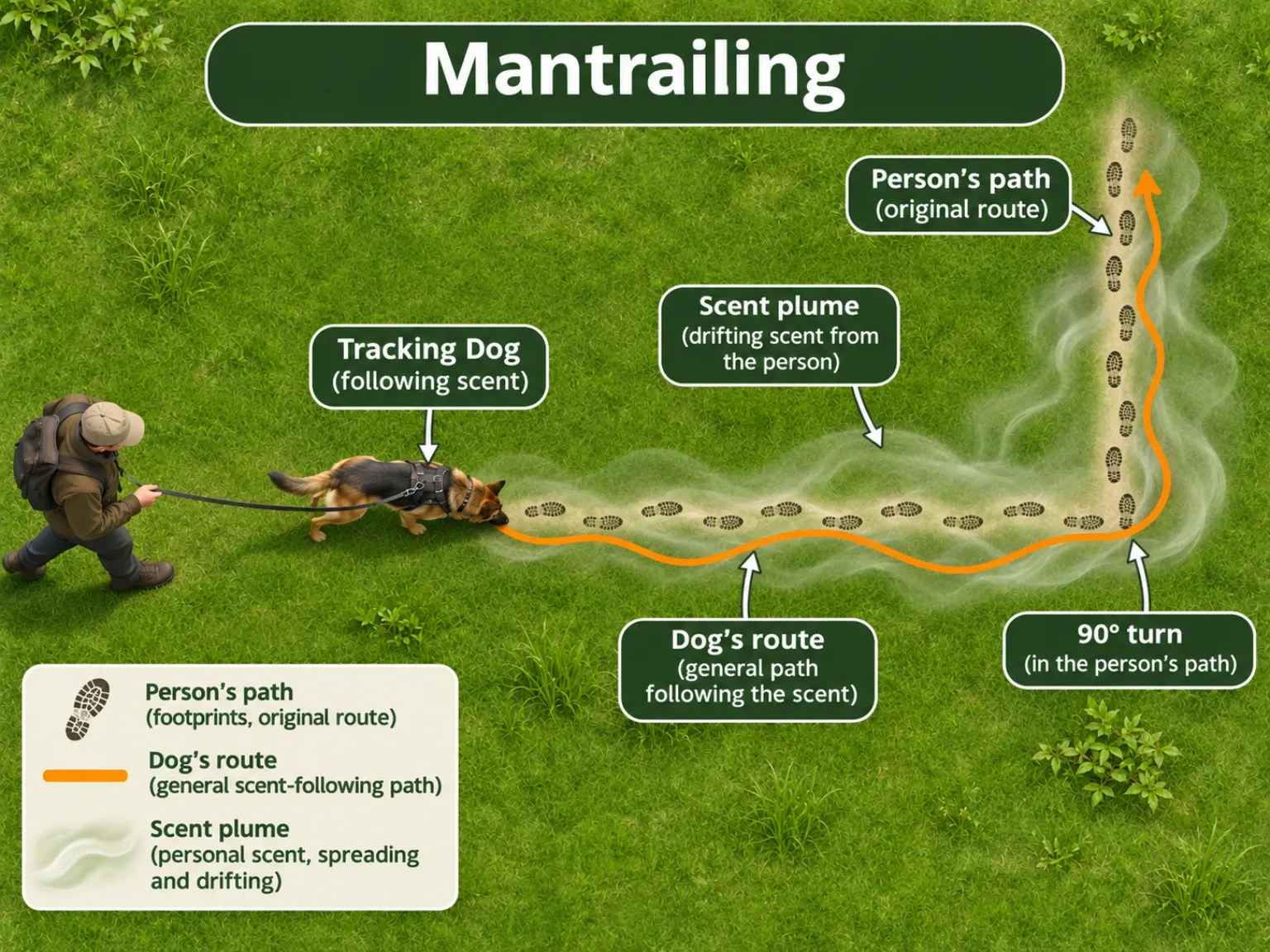
Human scent does not remain neatly confined to the ground where someone has walked. It can travel through the air, collect around vegetation and buildings, and move considerable distances depending on environmental conditions.
While scent pads can provide a valuable foundation, developing flexibility in how the dog searches is equally important in mantrailing.
2. Motivation-Based Training Methods
Other training systems focus heavily on developing the dog’s enthusiasm and desire to locate a person.
Runaways, fire trails and intensity starts are examples of methods used within this broader training philosophy.
These approaches can make searching an exciting and rewarding experience, encouraging the dog to actively engage in the activity.
However, a highly motivated dog that enthusiastically finds a person does not necessarily understand that it needs to locate one specific individual based on their scent.
Motivation is important, but so is understanding the task.
3. Harnessing the Dog’s Natural Searching Instincts
Dogs are naturally equipped to investigate their environment through scent.
Some training philosophies focus on developing these existing abilities rather than placing too many restrictions on how the dog searches.
A dog may investigate the ground, lift its head into the wind or move away from the exact route a person has taken.
To the inexperienced observer, it might appear that the dog has lost the trail. In reality, the dog may be following scent that has moved away from the original path.
This approach places considerable importance on independence, confidence and the handler’s ability to recognise and interpret the dog’s behaviour.
4. Scent Discrimination
Scent discrimination is a fundamental component of mantrailing.
Unlike a general search for human presence, mantrailing requires the dog to identify and follow the scent of a particular individual.
Different training systems introduce this concept at different stages of the dog’s development.
The challenge becomes particularly interesting in environments where numerous people have travelled through the same area.
Finding a person is one achievement. Finding the correct person is another.
Tracking, Mantrailing and Air-Scent Searching
Although these three activities share similarities, their objectives and emphasis can differ considerably.
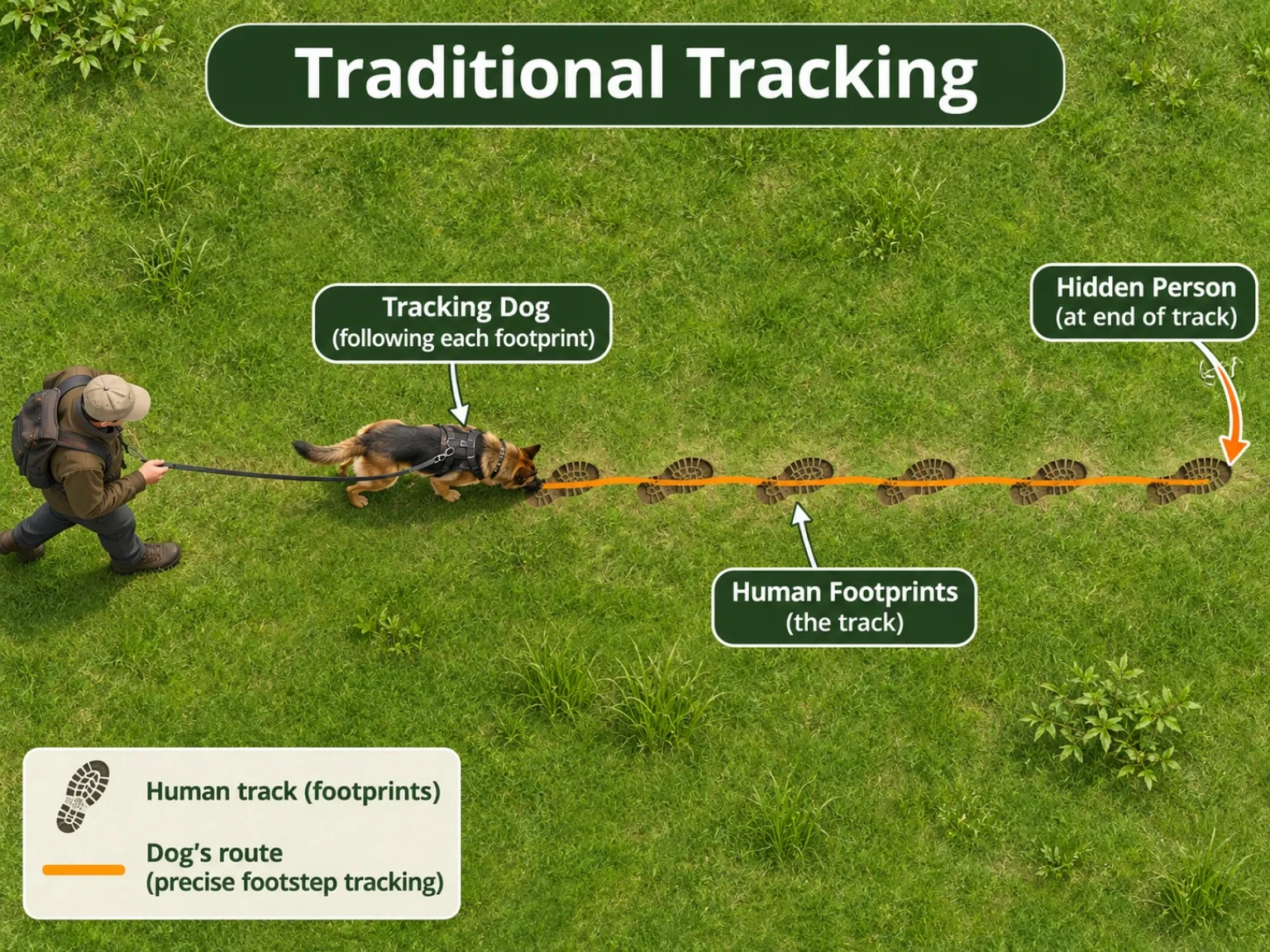
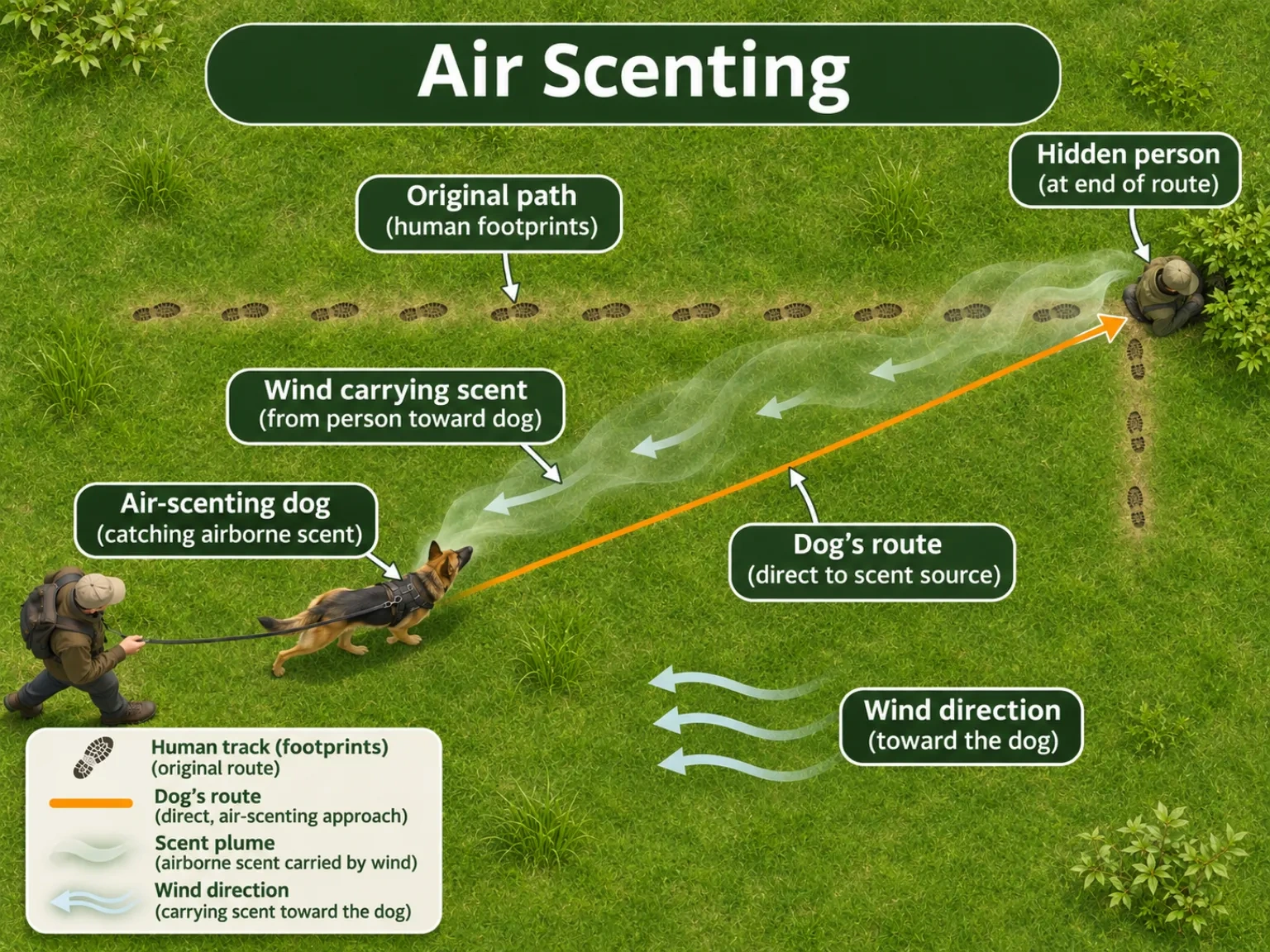
The diagrams below are simplified educational illustrations. Actual scent movement varies with conditions. Select any illustration to open it at full size.
Traditional tracking generally places greater emphasis on following the physical route taken by a person, often investigating scent and ground disturbance close to their footsteps.
Mantrailing focuses on following an individual’s scent, allowing the dog greater flexibility to investigate both ground-level and airborne scent.
Air-scent searching generally involves detecting human scent carried through the air to locate a person, without necessarily following their original route. Depending on the training, the search may or may not be specific to one individual.
These distinctions are not absolute. Dogs can naturally use a combination of scenting behaviours depending on the environment and the information available to them.
Wind, temperature, humidity, vegetation and surrounding structures can all influence how scent behaves.
Understanding these factors is an important part of becoming a more knowledgeable mantrailing handler.
Is One Mantrailing Training Method Better Than Another?
The answer is not necessarily as straightforward as it might seem.
Dogs differ considerably in their temperament, confidence, motivation, previous training and natural searching behaviour.
A method that produces excellent results with one dog may not be the most suitable starting point for another.
An effective training approach should ultimately develop:
- Motivation and enthusiasm for searching.
- Confidence and independent problem-solving.
- The ability to identify individual human scent.
- Persistence when scent becomes difficult to locate.
- Effective communication between dog and handler.
Rather than judging a training method solely on how quickly a dog finds someone, we should also consider what the dog is actually learning.
Mantrailing with Canine Revolution Dog Training
At Canine Revolution Dog Training in Coffs Harbour, we recognise the value of understanding different training methodologies and adapting our approach to the individual dog.
Mantrailing is not simply about teaching a dog to find someone. It is also about helping owners understand how their dogs think, communicate and experience the world through scent.
The diverse environments around the Coffs Coast and the NSW Mid North Coast provide exciting opportunities to explore this activity, from open grassy areas to bushland and more complex environments.
Mantrailing can provide both mental stimulation and an enjoyable opportunity to strengthen the relationship between dogs and their owners.
Whether you are interested in exploring your dog’s natural scenting abilities or developing your skills as a handler, contact Canine Revolution to learn more about our mantrailing and dog training programs in Coffs Harbour.
Discover what your dog is truly capable of when you learn to trust its nose.
Canine Revolution Dog Training
Coffs Harbour, NSW
0414 251 177

