
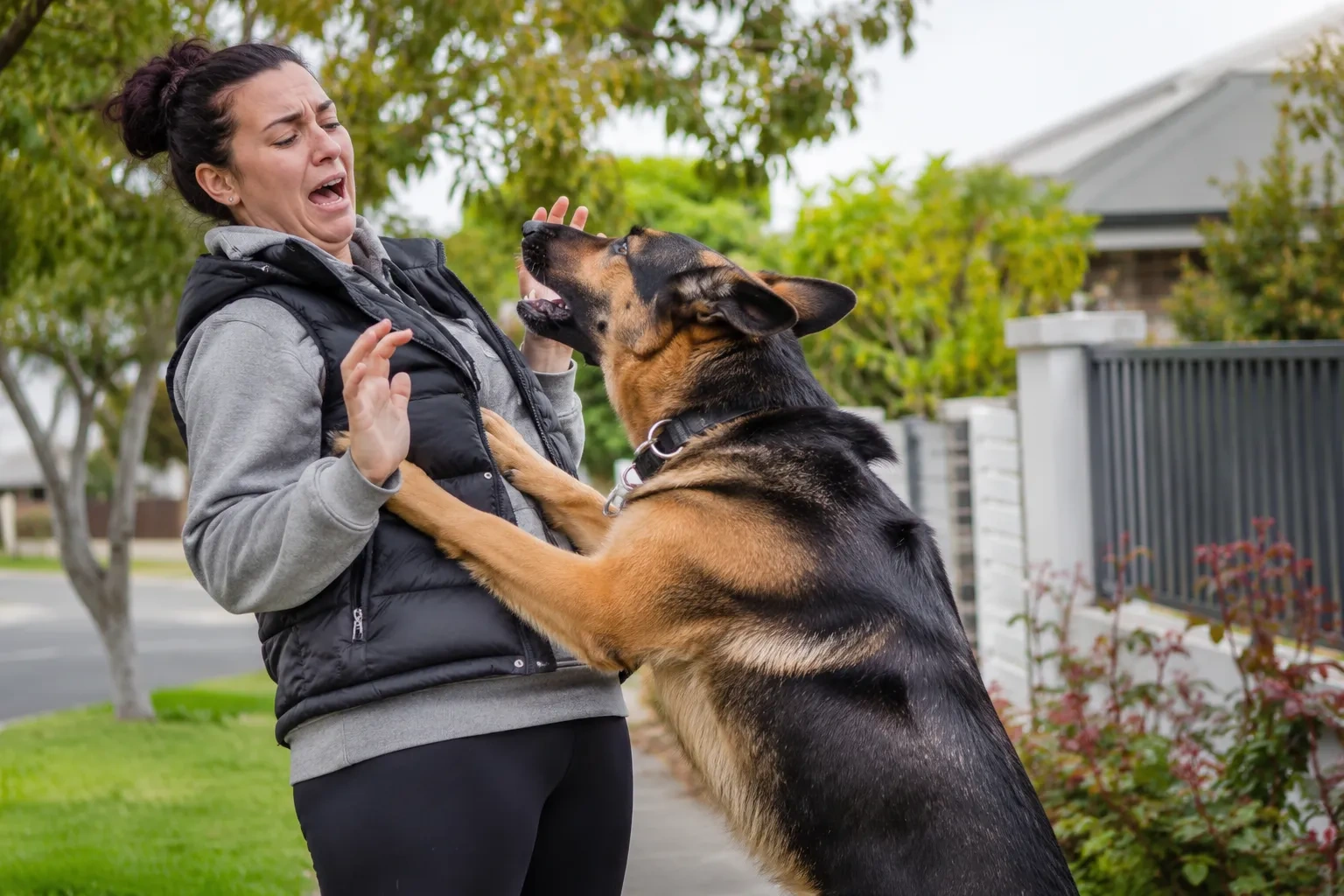
What if your dog isn’t going to grow out of its unwanted behaviour? What if it’s actually getting better at it?
Imagine being told that your dog will stop jumping on people, pulling on the lead and becoming uncontrollably excited around other dogs when it reaches two or three years of age.
So you wait.
Six months go by. Then twelve months. Then two years.
Your dog is now bigger, stronger and still doing exactly the same things.
Perhaps the behaviour has even become worse.
At Canine Revolution Dog Training in Coffs Harbour, I regularly meet dog owners who have spent months or years waiting for their dogs to grow out of unwanted behaviours.
Unfortunately, one of the most damaging pieces of advice a dog owner can receive is:
“Don’t worry, they’ll grow out of it.”
Waiting Is Not a Dog Training Strategy
As a professional dog trainer, I regularly hear comments such as:
- “I’ve been told he’ll settle down when he turns two.”
- “She’s still young. Apparently, she’ll grow out of the jumping.”
- “Everyone says he’ll eventually stop pulling on the lead.”
- “I thought he would have stopped toileting inside by now.”
- “She’s just excited around other dogs.”
The encouraging thing about hearing these comments is that these owners have recognised a problem and have contacted me for professional training.
What concerns me are the dog owners who haven’t.
They’re still waiting for something to change, unaware that their everyday routines could actually be strengthening the behaviours they want to eliminate.
Dogs may naturally become less energetic as they mature, but established behaviours don’t necessarily disappear with age.
In many cases, the longer a behaviour is practised and reinforced, the more established it becomes.
How Many Times Has Your Dog Practised the Wrong Behaviour?
Consider a dog that pulls on the lead.
Let’s imagine that during each daily walk, the dog successfully pulls its owner towards something it wants just ten times.
That’s:
- 70 opportunities to reinforce pulling in one week.
- 3,650 opportunities in one year.
- 7,300 opportunities over two years.
And that’s based on just ten successful repetitions per day.
These are illustrative numbers, but they demonstrate an important principle.
If you’ve been waiting two years for your dog to stop pulling, you may have given your dog thousands of opportunities to learn that pulling works.
Now ask yourself why your dog would suddenly stop performing a behaviour that has consistently produced a rewarding outcome.
Your dog hasn’t spent two years learning to walk nicely on the lead.
It has potentially spent two years learning how to pull.
Your Dog Doesn’t Know It’s Misbehaving
We tend to describe dog behaviours using human labels.
Jumping is bad.
Walking nicely is good.
Barking is naughty.
Sitting is obedient.
But dogs learn from the consequences of their behaviour, not from the labels we give them.
If jumping produces attention, pulling produces forward movement and barking produces an interesting response from the owner, those behaviours may continue.
The important question isn’t simply:
“Why is my dog doing this?”
It’s also:
“What is my dog getting out of doing this?”
Understanding that question can completely change the way you approach dog training.
Four Common Dog Behaviour Problems That Waiting Won’t Reliably Fix
1. Jumping on Visitors
A puppy jumps up and receives attention.
A young dog jumps up and receives affection.
An adult dog jumps up and receives a response from its owner.
If the dog finds those responses rewarding, why should the behaviour disappear?
Instead of waiting, we need to teach the dog that remaining calm and keeping four paws on the ground is a more effective way of receiving attention.
2. Pulling on the Lead
Whether you’re walking around the Coffs Harbour Jetty, along the beachfront at Sawtell or through your neighbourhood in Woolgoolga, your dog is constantly learning from its surroundings.
Every time pulling successfully gets your dog closer to an interesting smell, another dog or a favourite location, that behaviour may be reinforced.
Teaching loose-lead walking means changing the way your dog learns to navigate those environments.
The solution isn’t necessarily longer walks.
It’s teaching your dog how to walk appropriately.
3. Overexcitement Around Other Dogs
Your dog spots another dog across the street.
It becomes excited, starts pulling, barking or jumping, and eventually you allow it to say hello.
You might think you’re giving your dog an opportunity to socialise.
But your dog could be learning that becoming uncontrollably excited is the most effective way of gaining access to another dog.
Good social behaviour involves more than friendliness.
It also involves developing the ability to remain calm, responsive and under control around distractions.
4. Poor Recall
Your dog is having fun at the park.
You call it back, but it continues running around.
You repeat the command several times before eventually giving up.
From your dog’s perspective, ignoring the recall may allow the fun to continue.
If this happens repeatedly, your dog may learn that responding to your recall is optional.
Waiting for your dog to become older is not a reliable way of improving recall.
Reliable recall needs to be developed progressively through training, appropriate rewards and controlled practice.
A Real Board & Train Case: Eighteen Months of Waiting
One of the clearest examples I’ve experienced involved an eighteen-month-old dog that was still toileting inside its owner’s home.
The owners were waiting for the dog to grow out of the behaviour, but by eighteen months of age, indoor toileting had become an established habit.
The dog came to me for a three-week Board & Train program.
During those three weeks, it did not have a single toileting accident inside my home.
I established a structured routine, managed the dog’s access to the house and provided appropriate opportunities to go outside.
After approximately two weeks, I began giving the dog more freedom inside while maintaining close supervision.
I noticed that the dog had a particular tell. Whenever it needed to go outside, it would begin pacing near the window.
The moment I noticed that behaviour, I opened the door and allowed the dog outside. Appropriate toileting was rewarded.
When the dog returned home, I gave the owners a straightforward instruction.
For the first week, do not leave the dog unsupervised while it has free access to the house. If you cannot supervise, manage the dog’s freedom using an appropriate, safe area.
On the first day, the owners went to the bathroom themselves and left the dog unsupervised.
The dog had another accident.
Why?
The owners had become so accustomed to their previous routine that changing their own behaviour was difficult.
Once they followed the training instructions consistently, things improved.
This is why our dog training programs involve teaching owners as well as their dogs.
If we want our dogs to change, sometimes the first thing we need to change is ourselves.
Persistent toileting problems may also require veterinary assessment to rule out underlying medical conditions.
The Hidden Cost of Doing Nothing
Waiting doesn’t always mean maintaining the current situation.
It could mean allowing your dog to continue developing increasingly established habits.
A puppy that jumps on people can become a powerful adult dog that knocks people over.
A young dog that pulls on the lead can become an adult dog that its owner struggles to physically control.
A dog that ignores its recall can place itself in dangerous situations.
A dog that hasn’t learned to settle can make everyday household life unnecessarily stressful.
These problems can affect your ability to enjoy walks, invite visitors into your home, travel with your dog or simply relax together.
Early training isn’t just about obedience.
It’s about creating a better quality of life for both you and your dog.
What Should You Do Instead of Waiting?
When addressing unwanted dog behaviour, there are several important principles to consider.
First, identify what is maintaining the behaviour.
Second, manage the situation so your dog isn’t continually practising and being rewarded for the unwanted behaviour.
Third, teach your dog an appropriate alternative.
Finally, reinforce that alternative consistently until it becomes an established habit.
It sounds straightforward, but every dog and every household is different. This is where professional dog training can help identify why a particular behaviour is occurring and develop an appropriate training plan.
You don’t need to wait until the problem becomes unbearable before seeking help.
Is My Dog Too Old to Start Training?
Absolutely not.
Dogs can continue learning throughout their lives.
At Canine Revolution Dog Training, we work with puppies, adolescent dogs and mature adult dogs.
However, teaching a desirable behaviour from the beginning can be easier than changing a behaviour that has been repeatedly practised for several years.
If your dog is young, now is an excellent time to begin.
If your dog is older and already displaying unwanted behaviours, now is still an excellent time to begin.
What matters is that you stop relying on age alone to solve the problem.
Professional Dog Training in Coffs Harbour and the Mid North Coast
Canine Revolution Dog Training helps owners develop practical, reliable behaviour that improves everyday life with their dogs.
Based near Coffs Harbour, NSW, we work with dog owners from across the Coffs Coast and surrounding communities, including:
- Coffs Harbour
- Sawtell and Toormina
- Boambee and Bonville
- Woolgoolga
- Bellingen
- Urunga
- Nambucca Heads
- Coramba and surrounding areas
Our training programs address common challenges such as jumping, lead pulling, poor recall, overexcitement, difficulty settling and general household manners.
We offer puppy training, private dog training lessons, structured training programs and comprehensive Board & Train programs.
Our residential Board & Train programs are also available to owners travelling from further afield, including Sydney, Wollongong, Canberra, Byron Bay and other locations.
Whether you’re looking to establish good habits in a new puppy or address unwanted behaviours in an adult dog, we can help you develop a practical approach to training.
Stop Waiting. Start Training.
Every day your dog is learning something.
The question is whether it’s learning the behaviours you want or becoming better at the behaviours you don’t.
Don’t spend another six months, twelve months or two years hoping the problem will disappear.
Your dog doesn’t need another birthday to start behaving better. It needs an opportunity to learn something different.
Contact Canine Revolution Dog Training today to discuss your dog’s behaviour and find a suitable training program.
Visit: https://caninerevolution.au
Phone: 0414 251 177
Written by James Maturana, professional dog trainer and founder of Canine Revolution Dog Training, established in 2016.
Ready to address your dog’s unwanted behaviour? Speak with Canine Revolution Dog Training about the most suitable training program for you and your dog.

